
Slay The Spire 2 Characters Pros & Cons: Complete Guide For Every Hero Deck
 83
83
Slay the Spire 2 characters are the five playable heroes that each bring a mechanically distinct approach to climbing the Spire. The roster includes three returning characters from the original game — The Ironclad, The Silent, and The Defect — alongside two brand-new additions, The Regent and The Necrobinder. Each character starts with a unique relic, a fixed HP pool, and a card pool built around their individual game plan. Understanding what each hero does, which decks they support, and which relics accelerate their builds is the fastest way to stop losing runs and start finishing acts.
Every Slay The Spire 2 Character Explained
Characters unlock in a fixed sequence. The Ironclad is available from the start. Playing one run as the Ironclad unlocks the Silent. One run as the Silent unlocks the Regent. One run as the Regent unlocks the Necrobinder. One run as the Necrobinder unlocks the Defect. A run does not need to succeed — starting and giving up counts toward the unlock condition, meaning all five characters can be accessed in under five minutes if needed.
- The Ironclad
- The Silent
- The Regent
- The Necrobinder
- The Defect
The game rewards this organic approach: spending time with each character's card pool builds the pattern recognition that makes relic evaluation and build pivots feel instinctive rather than guesswork. My favorite character remains the Silent — her Poison into Accelerant payoff, the rhythm of a Sly cycling turn, and the way a well-timed Knife Trap clears an elite in one sequence are things no other character in the roster replicates — but every character in the chain earns its place before she does, and the run that unlocks her tends to be the run where the game finally clicks.

The Ironclad is the game's starting character and its most direct fighter. He stacks Strength to amplify every attack and heals 6 HP after every combat through his Burning Blood relic. His builds center on Strength scaling, Block conversion, and Exhaust synergies, and his mechanics are straightforward enough that new players can pilot him effectively from the first run.
The Silent operates through speed, card draw, and damage over time. She applies Poison to drain enemies across multiple turns, generates chains of zero-cost Shivs for burst damage, or uses the new Sly keyword to play discarded cards for free. Her damage output starts low and builds as the deck comes together.
The Regent introduces Stars as a second resource alongside Energy. Many of his cards spend both, and managing that balance is the core skill his builds demand. Once Stars are flowing, the Regent's cards hit considerably harder than those of the returning cast.
The Necrobinder fights as a duo with Osty, a reanimated skeletal hand that intercepts attacks through the Die For You power. Her two game plans are building Osty into a damage dealer or stacking the Doom debuff on enemies to execute them when their HP drops to or below their Doom count.
The Defect channels elemental Orbs — Lightning, Frost, Dark, Glass, and Plasma — that trigger passive effects each turn and stronger Evoke effects when cleared. A separate Claw build ignores Orbs entirely and wins through cycling zero-cost attacks.
Here we have a complete Slay The Spire 2 relics guide, where we covered about 250 relics. Welcome to explore.
The Ironclad
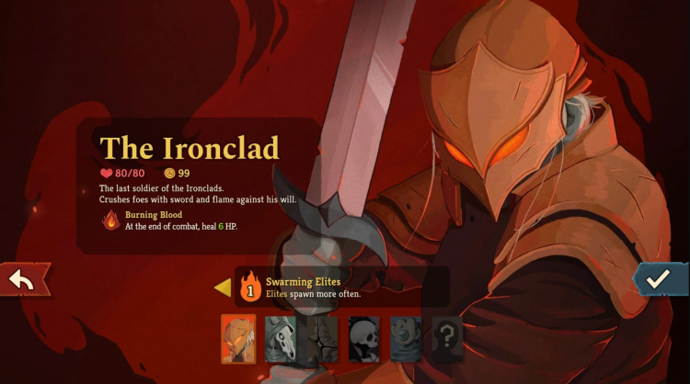
The Ironclad is the first character in the main Slay the Spire 2 game, available from the start with no unlock condition required.
- Health Points: 80
- Starting Relic: Burning Blood — heals 6 HP at the end of every combat
The Ironclad's cards revolve around three mechanics: Strength scaling, Block conversion, and Exhaust synergies. His Burning Blood relic provides consistent post-combat healing that smooths over bad draws and early damage without requiring dedicated healing cards. A Strength build stacks flat attack buffs through cards like Inflame and Fight Me, then hits with multi-strike attacks that multiply the bonus on each individual hit. A Block build uses Barricade to prevent Block from expiring between turns, then converts accumulated Block directly into damage through Body Slam. An Exhaust build relies on the trio of Corruption, Dark Embrace, and Feel No Pain to cycle Skills rapidly while generating passive Block and damage. A fourth option, the Bloodletting build, deliberately takes self-damage through cards like Rupture and Crimson Mantle and converts that HP loss into Strength stacks through Rupture's effect.
Pros:
- Highest starting HP of any character at 80
- Heals 6 HP after every combat through Burning Blood
- Straightforward mechanics with a low learning curve
- Multiple viable build paths available
- Strength scaling amplifies multi-hit cards on each individual hit
- Body Slam converts Block directly into damage
Cons:
- Several key cards carry high Energy costs
- Self-damage cards in the Bloodletting build require careful HP management
- Exhaust synergies become awkward without the full trio of core Powers
- Low ceiling compared to more complex characters once mechanics are understood
- Some builds require specific rare cards like Barricade to fully activate
The Ironclad suits players who want consistent results without managing secondary resources. His relic removes most of the HP anxiety that defines early runs on other characters, and his Strength scaling delivers clear, measurable payoffs from the first few cards placed into the deck.
Builds
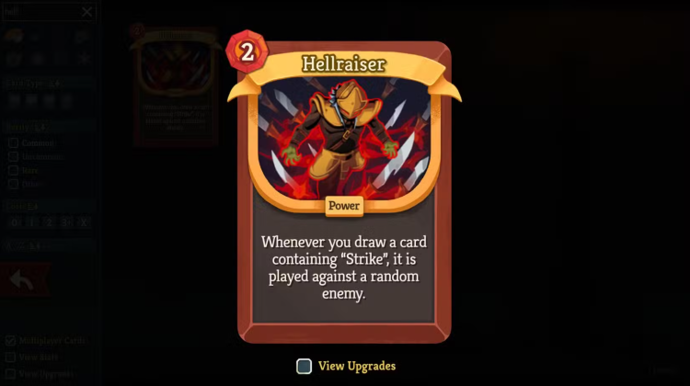
The Ironclad supports four main archetypes: Strength, Block, Exhaust, and Bloodletting. Strength is the most consistent starting point since the key cards appear frequently in early rewards. Block builds require Barricade to reach full potential, making them more draw-dependent. Exhaust builds need Corruption online before the synergies activate. Bloodletting is the most high-variance of the four, trading survivability for accelerated Strength gain.
Key Cards
The Strength build runs on multi-hit attacks and cheap buff generators. Both the Block and Exhaust builds share several cards, particularly those that generate Block through Skill plays.
- Twin Strike
- Inflame
- Fight Me
- Body Slam
- Barricade
- Corruption
- Dark Embrace
- Feel No Pain
- Rupture
- Crimson Mantle
- Breakthrough
- Demon Form
- Brand
- Thrash
- Juggernaut
Twin Strike and Thrash are the primary damage vehicles in a Strength build because each hit separately inherits the Strength bonus. Corruption makes all Skills cost zero Energy, which activates Feel No Pain's Block generation on every play and Dark Embrace's card draw simultaneously. Barricade is the card that separates a functional Block build from an exceptional one — without it, Body Slam only fires on turns with active Block generation.
Relics
Certain relics accelerate specific Ironclad builds from the moment they are picked up.
- Anchor
- Horn Cleat
- Permafrost
- Brimstone
- Ruined Helmet
- Charon's Ashes
- Cloak Clasp
- Centennial Puzzle
- Demon Tongue
- Self-Forming Clay
- Vambrace
- Sai
- Fresnel Lens
Anchor, Horn Cleat, and Permafrost provide early Block that buys time to set up Demon Form in Strength builds. Brimstone gives 2 Strength per turn but also buffs every enemy by 1, making it a strong choice in a deck built to close fights quickly. Ruined Helmet doubles the first Strength gain each combat, which compounds significantly with Inflame or Rupture activations.
The Silent

The Silent is the second character in the main Slay the Spire 2 game, unlocked by playing one run as the Ironclad.
- Health Points: 70
- Starting Relic: Ring of the Snake — draws 2 additional cards at the start of the first turn of each combat
The Silent has the lowest HP of the three returning characters at 70 and no native healing. Her Ring of the Snake relic draws two extra cards on turn one of every fight, which accelerates access to key cards from the first hand. She introduces the Sly keyword, new to Slay the Spire 2, which plays a card for free if it is discarded before the end of the turn. Her three main archetypes are Poison, Shivs, and Sly. Poison stacks a damage-over-time debuff that bypasses defensive mechanics like Plating and Hardened Shell but does nothing against Intangible and requires patience in early fights. Shiv builds generate and spam zero-cost daggers that Exhaust on play, relying on cards like Accuracy to double their base 4 damage and Knife Trap to dump fifteen to twenty Shivs into a single turn. Sly builds cycle through the deck by discarding cards that then play for free, creating chains of actions that would be impossible within the normal Energy budget. I think the Silent is the most rewarding character once her synergies come online — her Poison into Accelerant sequence can delete elite HP bars in two turns, and the Sly cycling feels unlike anything the other characters produce.
Pros:
- Ring of the Snake draws 2 extra cards on turn one of every combat
- Three distinct and viable archetypes provide flexibility across different runs
- Poison bypasses Plating, Hardened Shell, and other passive defenses
- Sly keyword enables multi-card chains beyond the normal Energy limit
- Shiv builds can output fifteen or more attacks in a single turn with Knife Trap
- Strong discard synergies through Tingsha and Tough Bandages relics
Cons:
- Lowest HP of any returning character at 70
- No healing available in her card pool
- Low direct damage output in early fights before synergies are established
- Shiv builds require Accuracy to deal meaningful damage
- Poison is slow against bosses that apply Artifact to block debuffs
- Sly builds need a thin deck to cycle reliably
The Silent punishes players who do not commit to a build direction early. She starts slow, and spreading card picks across multiple archetypes leaves her without the density of key cards she needs to function against elites and bosses.
Builds
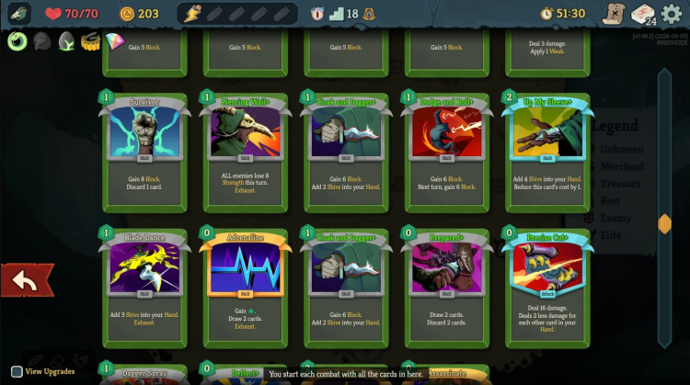
The Silent runs three archetypes across most runs: Poison, Shiv, and Sly. Poison is the most accessible starting point since the core cards appear in early Common and Uncommon rewards. Shiv builds require Accuracy to reach viable damage numbers. Sly decks perform best with thin deck counts, making aggressive card removal a priority from Act 1.
Key Cards
Each archetype pulls from a specific card set, though some cards contribute across multiple builds.
- Poisoned Stab
- Deadly Poison
- Noxious Fumes
- Accelerant
- Bubble Bubble
- Blade Dance
- Accuracy
- Infinite Blades
- Knife Trap
- Cloak and Dagger
- Flick-Flack
- Untouchable
- Acrobatics
- Tactician
- Tools of the Trade
- Master Planner
- Haze
- Outbreak
Noxious Fumes applies Poison to all enemies each turn without requiring a card play per target, which is the engine that makes multi-enemy Poison rooms manageable. Accuracy doubles Shiv damage from 4 to 8, and stacking two copies pushes it to 12 per Shiv. Tactician generates Energy whenever a Sly card is discarded, which funds the next chain of plays.
Relics
The Silent's relics split between damage amplifiers for Poison and Shiv builds and discard payoffs for Sly.
- Snecko Skull
- Twisted Funnel
- Unsettling Lamp
- Ninja Scroll
- Helical Dart
- Tingsha
- Tough Bandages
- Anchor
- Horn Cleat
- Captain's Wheel
- Nunchaku
- Shuriken
- Kunai
- Ornamental Fan
- Kusarigama
Snecko Skull adds one extra Poison stack whenever Poison is applied, which accelerates stacking across every card that applies the debuff. Twisted Funnel applies 4 Poison to all enemies at the start of every combat, which immediately enables Bubble Bubble on the first turn. Tingsha deals damage to a random enemy whenever a card is discarded during the player's turn, pairing directly with Sly discard chains.
The Regent
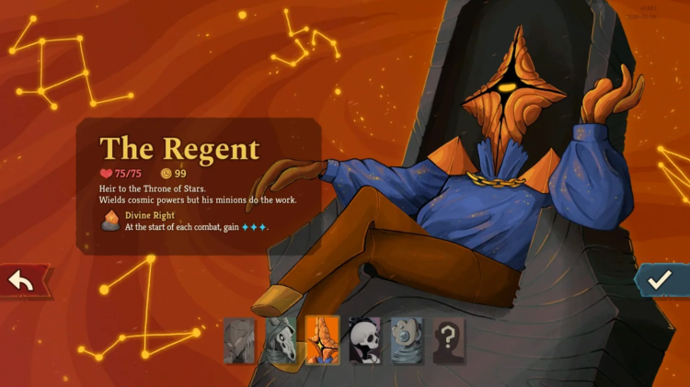
The Regent is the third character in the main Slay the Spire 2 game, unlocked by playing one run as the Silent.
- Health Points: 75
- Starting Relic: Divine Right — grants 3 Stars at the start of every combat
The Regent introduces Stars as a second resource that accumulates permanently until spent, with a maximum stockpile of 24. His cards frequently cost both Energy and Stars to activate, and his deck contains more varied Energy generation than other characters to compensate. His starting relic, Divine Right, grants 3 Stars at the start of each combat, providing a baseline income that funds his early turns. Two primary builds shape most Regent runs. The Sovereign Blade build uses Forge mechanics to escalate a single Innate 2-cost card, Sovereign Blade, from a strong single-target hit into a fight-ending sequence through cards like Conqueror and Seeking Edge. The Star build stockpiles Stars through generators like Hidden Cache and Shining Strike, then burns them through high-cost rare cards or Powers that passively reward Star spending, including Seven Stars as a direct damage nuke.
Pros:
- Strong combo potential through Star and Forge mechanics
- Divine Right provides 3 free Stars at the start of every combat
- Stars accumulate between turns, enabling explosive late-combat bursts
- Sovereign Blade scales into a fight-ending win condition
- More varied Energy generation than any other character
- High ceiling once resource management is understood
Cons:
- Managing two resources simultaneously adds significant decision complexity
- Stars are easy to mismanage, stalling damage output entirely
- Sovereign Blade builds require specific support cards to activate reliably
- Slow start compared to the Ironclad before the engine assembles
- High-end rare cards like Seven Stars are not consistently available
- Card selection is more punishing than on simpler characters
The Regent rewards players who plan two or three turns ahead. Mismanaging the Star and Energy balance stalls turns completely, but a well-sequenced hand produces damage spikes that the returning characters cannot match.
Builds
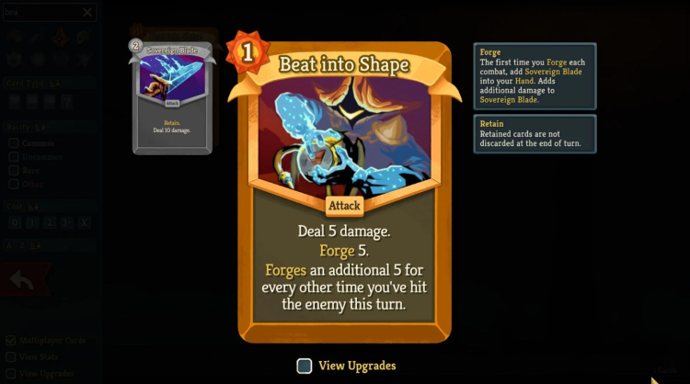
The Regent's two primary builds are the Sovereign Blade deck and the Star deck. The Sovereign Blade build is the more consistent starting point because Forge payoff cards appear across Common and Uncommon rarities. The Star build carries higher variance since its power depends on pulling specific rare cards to convert Star stockpiles into damage.
Key Cards
Each build draws from overlapping cards in some cases, particularly around Energy generation and early Block options.
- Cosmic Indifference
- Wrought in War
- Bulwark
- Summon Forth
- Beat into Shape
- Conqueror
- Furnace
- Seeking Edge
- Gather Light
- Glow
- Hidden Cache
- Solar Strike
- Convergence
- Shining Strike
- Alignment
- Genesis
- Gamma Blast
- Falling Star
Conqueror doubles the Sovereign Blade's damage output and is the card that converts the build from a mid-tier strategy into a genuine Act 3 threat. Genesis solves Star generation for certain builds independently once it resolves. Alignment trades Stars directly for Energy, which enables the explosive multi-card turns the Star deck is built to produce.
Relics
The Regent's relic priorities split between Forge acceleration and Star generation.
- Fencing Manual
- Lunar Pastry
- Mini Regent
- Galactic Dust
- Regalite
Fencing Manual activates the Sovereign Blade from turn one of every combat, removing the setup cost that slows the build in early fights. Lunar Pastry generates 1 Star at the end of every turn with no card play required, providing compounding passive income across long combats. Mini Regent gives 1 Strength the first time a Star is spent each turn, which scales attack damage steadily in builds that spend Stars frequently.
The Necrobinder
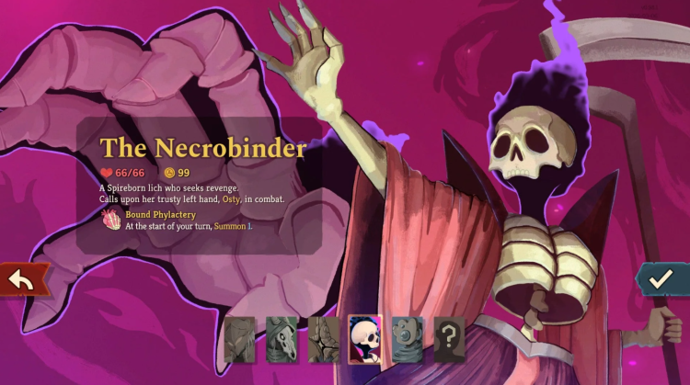
The Necrobinder is the fourth character in the main Slay the Spire 2 game, unlocked by playing one run as the Regent.
- Health Points: 66
- Starting Relic: Bound Phylactery — summons Osty at the start of each turn
The Necrobinder starts with 66 HP, the lowest base health in the roster. Her starting relic, Bound Phylactery, summons Osty — a reanimated skeletal hand — at the start of each turn. Osty begins with 1 HP but grows through Summon effects, and its Die For You power automatically intercepts any attack that would otherwise strike the Necrobinder. Every Summon effect adds to Osty's current and maximum HP. If Osty dies, any Summon effect raises it again at the start of the next turn, but the extra HP is lost and it restarts at 1 HP. Osty counts as its own unit for debuff purposes, so Weak, Vulnerable, and Strength drains applied to the Necrobinder do not affect it. Two builds define most runs: the Doom build and the Osty build. Doom stacks a death-mark debuff on enemies that executes them when their HP drops to or below their Doom count at the end of their turn, bypassing Block entirely. The Osty build uses Summon mechanics to grow Osty into a durable damage dealer that also generates Block through its attacks.
Pros:
- Osty absorbs all incoming attacks through Die For You, acting as a second HP pool
- Doom bypasses Block and ignores enemy defensive mechanics entirely
- Excellent card draw through Souls resource
- Strong manipulation of Draw and Discard piles
- Doom enables high kill-range execution setups against elites and bosses
Cons:
- Lowest base HP of any character at 66
- Requires high synergy density to function consistently
- Deliberate Osty sacrifices through Bone Shards prevent immediate re-summon
- Doom builds need Block support to survive until the execution clock resolves
- Slower playstyle that struggles when key cards do not appear in early rewards
The Necrobinder's low HP makes the first few rooms of any run dangerous if Osty dies and Summon effects are not yet in the deck. Prioritizing at least minimal Block coverage before committing to either archetype reduces early run failures substantially.
Builds
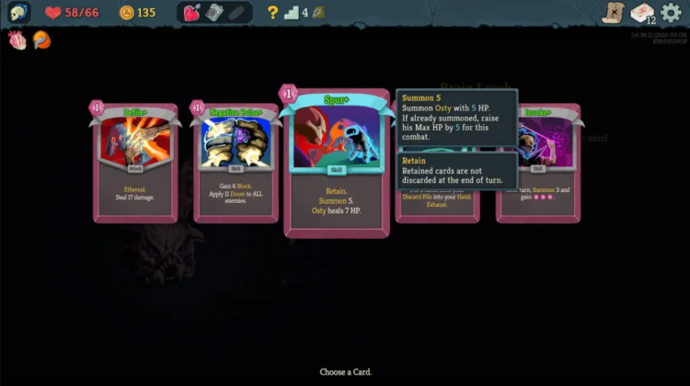
The Necrobinder runs two primary archetypes: Doom and Osty. Doom builds carry higher damage potential but require Block support to survive the delay between debuff application and enemy execution. Osty builds are more defensively stable but depend on keeping Osty alive across consecutive fights, which becomes harder in Act 2 without sufficient Summon density.
Key Cards
The two archetypes pull from distinct card sets with minimal overlap.
- Blight Strike
- Defile
- Negative Pulse
- Scourge
- Deathbringer
- Delay
- Death's Door
- End of Days
- No Escape
- Oblivion
- Shroud
- Time's Up
- Pull Aggro
- Snap
- High Five
- Rattle
- Fetch
- Flatten
- Necro Mastery
- Reanimate
- Sic Em
- Spur
Deathbringer applies AoE Doom and Weak simultaneously, combining the execution setup with a damage reduction debuff that helps the Necrobinder survive the turns before Doom resolves. Shroud converts Doom trigger events into Block, turning executions into survivability gains. Rattle is the Osty build's primary multi-hit source and generates significant combo potential alongside Fetch and Sic Em.
Relics
Relic priorities split by archetype but share some overlap in Block generation.
- Book Repair Knife
- Undying Sigil
- Bone Flute
Book Repair Knife heals 3 HP whenever a non-Minion enemy dies to Doom, providing consistent sustain in a character who otherwise has no post-combat healing. Undying Sigil reduces damage from enemies whose Doom stacks match or exceed their remaining HP by 50 percent, cutting the danger of surviving the final turn before execution resolves. Bone Flute grants 2 Block whenever Osty attacks, which accumulates across multi-hit Osty builds.
The Defect

The Defect is the fifth character in the main Slay the Spire 2 game, unlocked by playing one run as the Necrobinder.
- Health Points: 75
- Starting Relic: Cracked Core — channels 1 Lightning Orb at the start of every combat
The Defect starts with 75 HP and channels one Lightning Orb each combat through Cracked Core. It enters play with 3 empty Orb slots. Lightning Orbs hit a random target for 3 plus Focus damage each turn and deal 8 plus Focus on Evoke. Frost Orbs generate 2 plus Focus Block per turn. Dark Orbs do nothing passively but gain 6 damage per turn and release it all at once on Evoke against the lowest-HP enemy. Glass Orbs deal 4 plus Focus damage to all enemies per turn, reducing by 1 each turn until reaching zero. Plasma Orbs generate 1 Energy at the start of each turn regardless of Focus. Evoke either happens through dedicated cards like Doublecast or when new Orbs overfill the available slots, pushing the leftmost Orb out. A separate Claw build skips Orbs entirely and wins through cycling zero-cost attacks, particularly Claw cards that grow stronger with each copy played.
Pros:
- Diverse playstyles between Orb cycling and Claw spam
- Orb system generates passive damage, Block, and Energy simultaneously
- Plasma Orbs provide free Energy generation independent of Focus
- Dark Orbs accumulate damage across turns for high Evoke payoffs
- Strong Power card synergies across all builds
- Can heal after combat in some configurations
Cons:
- Less burst damage than Strength-scaling or Shiv builds on other characters
- Some cards require balancing immediate benefit against long-term Orb setup
- Orb builds feel slow without Focus scaling to amplify passive effects
- Claw builds dilute draw by adding too many zero-cost cards without enough of the right ones
- Certain cards like Consume and Hyperbeam conflict with each other if both are drafted
Builds

The Defect runs two primary builds in the current early access build: the Orb cycling deck and the Claw deck. Orb builds benefit from Focus scaling through cards like Defragment and Hotfix, which amplify every passive Orb effect simultaneously. Claw builds need All For One and Scrape to cycle Claw cards back into hand and maintain the damage chain across turns.
I see players draft both Consume and Hyperbeam in the same run, which creates a conflict since Consume removes an Orb slot permanently — exactly the opposite of what Hyperbeam needs to function. Committing to one build direction early and removing cards that conflict with it is more important for the Defect than for any other character.
Key Cards
Each build draws from a distinct card set, though draw and cycling tools appear across both.
- Claw
- Momentum Strike
- Beam Cell
- Scrape
- FTL
- All For One
- Hologram
- Feral
- Panache
- Ball Lightning
- Cold Snap
- Coolheaded
- Capacitor
- Defragment
- Loop
- Thunder
- Hailstorm
- Multi-Cast
- Voltaic
- Tesla Coil
- Machine Learning
- Flash of Steel
All For One retrieves every zero-cost card from the discard pile into hand simultaneously, which reloads the entire Claw package in a single play. Defragment adds Focus permanently, compounding every Lightning, Frost, Glass, and Dark Orb effect for the rest of the run. Capacitor adds Orb slots, enabling more Orbs to sit in the queue before Evoke triggers, which is particularly valuable for Dark Orb setups that need time to accumulate damage.
Relics
Relic priorities split between Orb amplifiers and Claw cycling tools.
- Cracked Core
- Emotion Chip
- Gold-Plated Cables
- Metronome
- Runic Capacitor
- Data Disk
- Power Cell
- Iron Club
- Nunchaku
- Shuriken
- Kunai
- Ornamental Fan
- Kusarigama
Emotion Chip triggers all Orb passives at the start of a turn if HP was lost the previous turn, which can produce three to five simultaneous Orb activations in a single turn. Metronome deals 30 damage to all enemies the first time seven Orbs are channeled each combat — achievable in an Orb-heavy build with Capacitor and Defragment online. Iron Club draws a card every four cards played, which sustains the hand size in Claw builds that burn through the deck in two to three turns.
Slay The Spire 2 Organic Characters Unlocking

The unlock chain in Slay the Spire 2 is not an arbitrary progression gate — it is a deliberate sequencing designed to introduce mechanical complexity gradually. The Ironclad teaches direct combat fundamentals. The Silent adds resource efficiency and debuff timing. The Regent introduces dual-resource management. The Necrobinder adds a persistent companion unit and execution mechanics. The Defect layers Orb economy and passive resource generation on top of everything learned before. Playing one or two runs per character before moving to the next lets each mechanic settle before the next layer arrives.
More on Slay The Spire 2 in our beginner's guide, where we've mapped out the perfect first playthrough on paper.
Rushing through unlocks to reach a specific character skips the progression the game was built around. Each character teaches something the next one requires. The order exists for a reason, and running with it produces better players faster than skipping ahead.

Vitalii Diakiv writes gaming blogs and guides, focusing on the latest announcements and games matched with pop-cultural phenomena. Second, he covers esports events Counter-Strike 2, Marvel Rivals, League of Legends, and others.



 Los Ratones Lost the Playoffs but Won the HeartsExplore how Caedrel's team Los Ratones performed at LEC Versus 2026. Learn about their tournament results, massive fan support, and the future of the roster after leaving the project.
 Chillplay
 Rumors: Caps Will Be The Next Hall Of Fame LegendWill LEC star Caps be the next player in the LoL Hall of Legends? We discuss his career, media impact, and the regional pattern after Faker and Uzi that points to him as the prime candidate.Chillplay
 ARC Raiders: How to Solve the Controlled Access Zone Puzzle on Dam BattlegroundsA complete guide to the Controlled Access Zone puzzle in ARC Raiders. Find out where the location is on Dam Battlegrounds.
 stawraith
 Marathon: How To Unlock Factions and Get Their RewardsMarathon launches March 5, 2026 on PC, PS5, and Xbox Series X|S — here is how Factions work.
 vitaliiD

 #157
#157 The Huns Esports
 #28
#28 TYLOOWatch match